


Human civilisation has grown thanks to amazing technological breakthroughs. These changes have deeply altered our lives. From old inventions to new wonders, they show our greatest creativity and problem-solving skills.
The history of technology shows a line of innovation from our ancestors’ stone tools to today’s digital age. Each time, new inventions changed societies and moved human progress forward.
These key moments in technology didn’t just happen. They came from years of learning, trying, and dreaming. They opened up new ways to talk, travel, heal, and live that our ancestors couldn’t dream of.
This journey honours the most important innovations that made our modern world. It shows how each breakthrough led to the next step in our shared history.
What Are Some of the Greatest Technological Achievements in History?
Ancient people created amazing technologies that laid the foundation for today’s world. These foundational inventions came from basic needs and changed society forever. The earliest prehistoric innovations made tools that influenced human progress for millennia.
The Wheel: Revolutionising Transport and Machinery
The wheel emerged around 4000 BC in Eastern Europe. Finds in Ukraine, Poland, and Germany show early wheel designs. This ancient technology changed how we moved, farmed, and built machines.
Before the wheel, moving heavy things was hard. Sledges and rollers were used. But the wheel made moving things easier and more efficient.
It helped farmers move more harvests. Traders could carry goods further. The wheel was key for growth and sharing cultures.
Related Posts:




Writing Systems: The Dawn of Recorded Knowledge
Writing started in Sumer and Egypt around 3200 BC. These foundational inventions marked a big change from prehistory to recorded history. They helped keep and share knowledge for years.
Early writing used simple pictures for objects and ideas. Sumerians used cuneiform on clay tablets. Egyptians had hieroglyphics with detailed pictures.
Writing changed how we kept records and made laws. It helped in literature and science too. This prehistoric innovation started education and keeping cultures alive.
Even earlier, stone tools from Kenya (3.3-2.6 million years ago) show our long journey in technology. Each ancient technology built on what came before, leading to ongoing progress.
Medieval Innovations: Organising Societies and Knowledge
The medieval period saw major inventions that changed how societies were organised. These medieval inventions helped manage information and time. They shaped our world for centuries.
The Printing Press: Spreading Ideas Across Continents
Johannes Gutenberg’s invention in the mid-15th century changed how we share knowledge. His Gutenberg printing press made books fast and easy to produce.
This made books more available in Europe. People could read about religion, science, and literature more easily.
The press helped more people learn to read. It also led to the growth of libraries. It was a key factor in the Renaissance, helping ideas spread quickly.
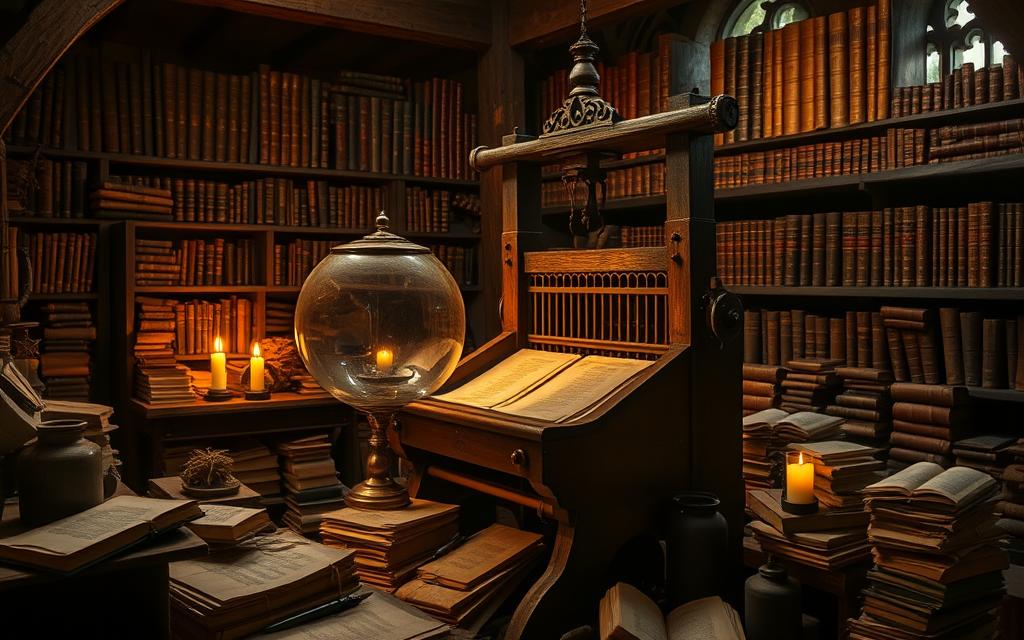
This German invention changed how we keep and share knowledge. It’s one of the most important inventions in history.
Mechanical Clock: Standardising Time Measurement
At the same time, there were big steps forward in timekeeping history. The mechanical clock brought precise time to medieval society.
These complex devices helped cities plan better. They made it easier to manage work, religious events, and daily life.
The clock helped science and city planning. It set the stage for global time standards.
This innovation helped us plan our days better. It’s another key step in medieval progress.
These inventions helped organise knowledge and time. They laid the groundwork for more complex societies to grow and thrive.
Industrial Revolution: Transforming Production and Communication
The late 18th and early 19th centuries saw a huge change in society. This time, known as the Industrial Revolution, changed how people worked, talked, and lived. Two key industrial revolution inventions had a big impact.
These inventions didn’t just make things better; they started new ways of making things and sharing information. The move from farming to industry was a big change for humans.
Steam Engine: Powering the Age of Industry
Scottish engineer James Watt made a big change in 1775. His James Watt steam engine made steam power useful for work. This was a big step forward.
This engine changed many industries. Factories could now use machines without water power. This let industries grow anywhere.
Transport also changed with steam power. Locomotives and ships moved faster, making trade easier.
This change made economies grow fast. Countries moved from farming to industry. This raised living standards for many.
Telegraph: Instant Communication Over Distances
Steam power changed how we made things, but Samuel Morse’s 1835 invention changed how we talked. The Morse telegraph sent messages fast over long distances.
This made old ways of sending messages slow. News and business talks happened much faster. The telegraph made the world feel smaller.
Morse’s code of dots and dashes was simple but effective. It helped early electrical systems and set standards for later tech. The telegraph is seen as a key step towards the Internet.
| Invention | Inventor | Year | Primary Impact | Secondary Effects |
|---|---|---|---|---|
| Steam Engine | James Watt | 1775 | Mechanised production | Urbanisation, increased trade |
| Telegraph | Samuel Morse | 1835 | Instant communication | Faster business decisions, global news |
| Spinning Jenny | James Hargreaves | 1764 | Textile manufacturing | Clothing affordability, export growth |
| Power Loom | Edmund Cartwright | 1785 | Automated weaving | Factory system expansion, labour shifts |
These industrial revolution inventions changed how we make and talk. The James Watt steam engine gave power, and the Morse telegraph helped coordinate work over long distances.
These inventions have shaped our world. They show how new tech can open up new possibilities for us.
Medical Breakthroughs: Advancing Human Health
Our journey through medical history is a huge achievement. It has changed how we deal with illness and made us live longer. From old healing ways to today’s medical wonders, fighting disease has come a long way.
On 10th April, World Science and Technology Day, we celebrate those who have changed our world. Their work saves millions of lives every year.
Vaccination: Eradicating Diseases Globally
Vaccination is a big step forward in fighting diseases. Edward Jenner’s smallpox vaccine in 1796 showed that weak pathogens can build immunity. This idea is the base of modern immunology.
Vaccines have done the impossible. Smallpox, which killed 300 million in the 20th century, was wiped out in 1980. Polio, once feared worldwide, now only exists in a few places.
Today, vaccines protect against many diseases:
- Measles, mumps and rubella (MMR)
- Diphtheria, tetanus and pertussis (DTP)
- Human papillomavirus (HPV)
- Seasonal influenza
The latest in vaccine science is mRNA technology. It helped make COVID-19 vaccines fast during the pandemic.
Antibiotics: Fighting Bacterial Infections
Alexander Fleming found penicillin in 1928, changing how we treat infections. His discovery showed a way to kill bacteria without harming people. This started the antibiotic era.
Before antibiotics, infections were often deadly. Even simple surgeries were risky. Diseases like pneumonia and tuberculosis had high death rates.
Antibiotics work in different ways:
- Destroying bacterial cell walls
- Inhibiting protein synthesis
- Interfering with DNA replication
The table below shows major antibiotic classes and their primary uses:
| Antibiotic Class | Discovery Year | Primary Applications | Notable Examples |
|---|---|---|---|
| Penicillins | 1928 | Respiratory infections, skin infections | Penicillin G, Amoxicillin |
| Cephalosporins | 1945 | Surgical prophylaxis, meningitis | Ceftriaxone, Cephalexin |
| Tetracyclines | 1945 | Acne, Lyme disease, malaria | Doxycycline, Minocycline |
| Macrolides | 1952 | Pneumonia, strep throat | Erythromycin, Azithromycin |
| Fluoroquinolones | 1962 | Urinary tract infections, anthrax | Ciprofloxacin, Levofloxacin |
These medical breakthroughs keep improving our health. They show our amazing ability to innovate against health challenges. The ongoing research in these fields promises even more progress in fighting diseases.
Twentieth Century Electronics: The Rise of Computing
The mid-20th century saw a big change in how we handle information. It moved from mechanical to electronic systems. This change led to our digital world today. Key devices from this time were major steps forward in technology.
Transistor: The Building Block of Modern Electronics
In 1947, John Bardeen, Walter Brattain, and William Shockley at Bell Laboratories made a huge discovery. They invented the transistor, which replaced old, unreliable vacuum tubes.
The transistor was a game-changer. It was smaller, used less energy, and worked better than vacuum tubes. It could boost electrical signals and switch them on and off, perfect for computers.
This small device became the base for all modern electronics. The transistor allowed for smaller, more powerful devices. Without it, our digital world wouldn’t be the same.
Personal Computer: Democratising Computing Power
Computers went from huge machines to small desktops. Early computers needed special places and teams to run. The personal computer changed that.
In 1971, John Blankenbaker’s Kenbak-1 was the first personal computer. It was simple but showed that computers could be for everyone, not just big companies.
The big leap was the microprocessor. It put a whole computer on one chip. This made computers smaller, cheaper, and easier to make.
This change put computers in homes and offices everywhere. The personal computer went from a special tool to a must-have item. It changed how we work, talk, and find information.
| Technology | Year Introduced | Key Innovators | Primary Impact |
|---|---|---|---|
| Transistor | 1947 | Bardeen, Brattain, Shockley | Replaced vacuum tubes, enabled miniaturisation |
| Kenbak-1 | 1971 | John Blankenbaker | First recognised personal computer |
| Microprocessor | 1971 | Intel Corporation | Integrated CPU on single chip |
| IBM Personal Computer | 1981 | IBM team | Standardised PC architecture |
The mix of transistor tech and microprocessors was a big leap. These changes made computers available to many, not just a few. The 20th century’s electronic revolution keeps shaping our digital world today.
Digital Connectivity: The Internet and Beyond
The late 20th century saw a huge leap in global communication. This era changed how we share and interact over long distances.
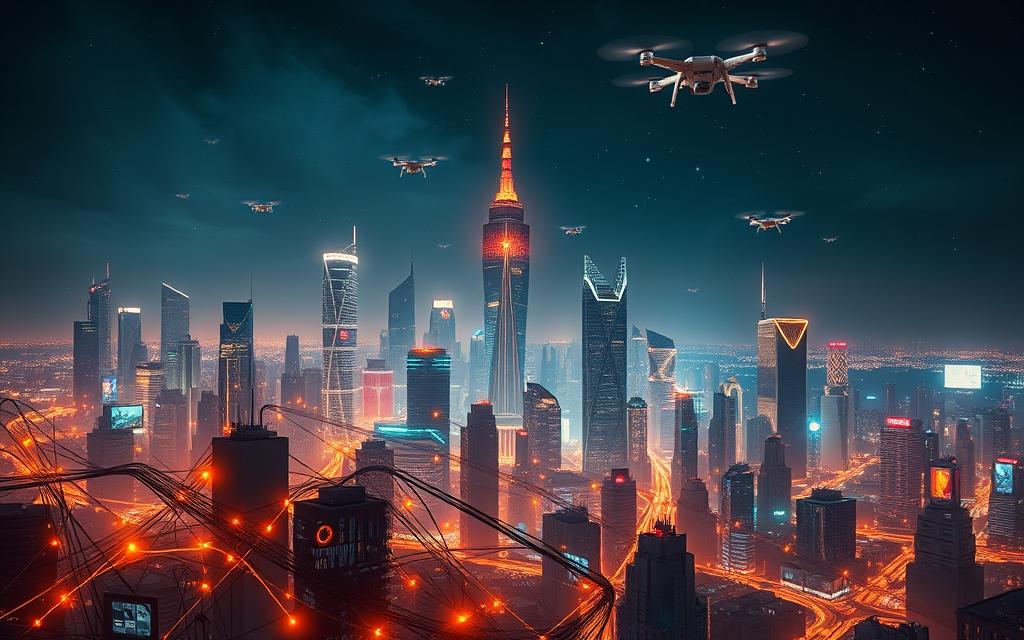
Internet: Connecting the World in Real Time
In 1969, four university computers linked up to ARPAnet. This was the start of the global internet.
Vinton Cerf made a big breakthrough in the late 1970s. He created the Transmission Control Protocol (TCP) for reliable file transfers.
This protocol was key for internet communication. It let different systems share data easily. The history of the internet shows how standards made global connections possible.
World Wide Web: Organising Global Information
Tim Berners-Lee introduced the World Wide Web in 1991. He worked at CERN and made information easy to find.
The web’s links and browsers changed how we find knowledge. Now, anyone with internet can access global information.
Berners-Lee wanted to make information open to all. His vision has changed how we live and work.
The web’s impact is huge in our lives today. It has changed business and how we connect with each other.
These inventions keep evolving, making connections even stronger. The internet and web are key to our connected world.
Contemporary Advancements: Sustainability and Intelligence
Today, technology tackles big challenges with new ideas. It focuses on saving the planet and using artificial intelligence. These changes are changing how we live and work.
From green energy to smart algorithms, these steps show our effort to solve global problems. They show how we can innovate when facing big challenges.

Renewable Energy Technologies: Combatting Climate Change
Switching to green energy is key. Solar and wind power have grown a lot in recent years.
These clean options are better than fossil fuels. They cut down carbon emissions and give us steady power.
Some important green tech includes:
- Advanced photovoltaic solar panels with better efficiency
- Offshore wind farms using stronger ocean winds
- Grid-scale battery storage systems for steady power
- Smart grid technologies for better energy sharing
These techs keep getting better and cheaper. They’re essential in the fight against climate change.
Artificial Intelligence: Transforming Industries and Daily Life
Artificial intelligence is another big area of tech with big effects. It started with Alan Turing’s work in the 1950s.
Now, AI can do things we thought were impossible. It can look through lots of data, spot patterns, and predict things with great accuracy.
AI is used in many ways today:
- Machine learning helps in healthcare
- Natural language processing powers chatbots and translators
- Computer vision helps self-driving cars and security
- Generative AI creates content and solves tough problems
AI changes many fields, from making things to managing money. It also makes our daily lives better with personal assistants and smart homes.
The Internet of Things links devices to AI, making things smarter. This leads to better cities, more efficient travel, and smarter use of resources.
As AI grows, it will change society even more. These advancements are some of the biggest in modern computing.
Conclusion
Human history shows a path of progress, thanks to our ability to innovate. From simple tools to advanced systems, each step forward has been built on what came before. This journey has changed how we live, work, and connect with the world.
The impact of these technologies is huge. They’ve tackled big problems, raised our standard of living, and brought people together worldwide. Every new invention, from the printing press to the internet, has boosted our knowledge and skills.
Looking to the future, innovations in green tech and AI will tackle big global issues. New energy sources and smart systems could help us live in harmony with our planet. These advances keep our tradition of using tech to solve problems.
This look back at our achievements shows our never-ending quest to better ourselves. The story of technology is one of endless growth, with each new generation adding to the past. Our biggest innovations have not just created tools and systems. They have shaped our very civilisation.
FAQ
What is considered the earliest major technological achievement?
The invention of the wheel around 4000 BC in Eastern Europe is a key achievement. It changed transport, agriculture, and machinery. This laid the foundation for future innovations.
How did the printing press change society?
Johannes Gutenberg’s printing press in the 15th century changed everything. It made books more available, boosting literacy and spreading ideas fast. This led to big cultural and scientific leaps.
What role did the steam engine play in the Industrial Revolution?
James Watt’s steam engine in 1775 was a game-changer. It powered factories, trains, and ships. This shift from farming to industry sparked huge growth and city expansion.
Why are vaccination and antibiotics considered critical medical breakthroughs?
Vaccines have wiped out diseases like smallpox. Antibiotics have changed how we fight bacterial infections. Together, they’ve cut death rates and improved health worldwide.
How did the transistor influence modern electronics?
The transistor, invented in 1947, replaced big vacuum tubes. It made electronics smaller and more reliable. This is why we have today’s computers and phones.
What is the difference between the Internet and the World Wide Web?
The Internet is a network of computers, starting with ARPANET in 1969. The World Wide Web, created in 1991, is a way to link documents online. It uses browsers and links to connect us.
How is artificial intelligence shaping the future?
AI, starting with Alan Turing in 1956, is changing many areas. It uses machine learning and automation. AI helps in healthcare, transport, and solving big problems.
What are the benefits of renewable energy technologies?
Solar and wind power are key for a greener future. They cut down on fossil fuel use and emissions. They’re vital for fighting climate change and securing our energy future.
How has technological innovation generally impacted human civilisation?
Innovation has always driven progress and change. From ancient tools to AI today, it has made life better. It has expanded our knowledge, connected us, and tackled global issues, showing the power of human creativity.